A new website gets at the heart of the teachings of Christianity’s earliest preachers and teachers.
It’s little wonder why a Bible-saturated Christian would want to know what men like these had to say about the Christian life. After all, Irenaeus (140-202 AD) was a disciple of Polycarp (69-155 AD), and Polycarp was a disciple of St. John (6-100 AD)—an Apostle of the incarnate Christ and the author of one of the four Gospels.
So…what did they say?
Well, needless to say, a lot. The Ancient Christian Commentary on Scripture set has twenty-nine volumes…and that’s just the commentary on Scripture. It’s hard to know where to begin, and wading from start to finish through eight centuries of writing from dozens of scholars—from Ignatius of Antioch to Tertullian to John Chrysostom to Augustine—feels like a very daunting prospect.
Enter ChurchFathers.org…..a refreshingly understated resource cast out for whoever was meant to find it. The sleek, no-frills design offers a direct portal into the teachings of the Church Fathers, one that’s rich with substance but easy to navigate and digest.
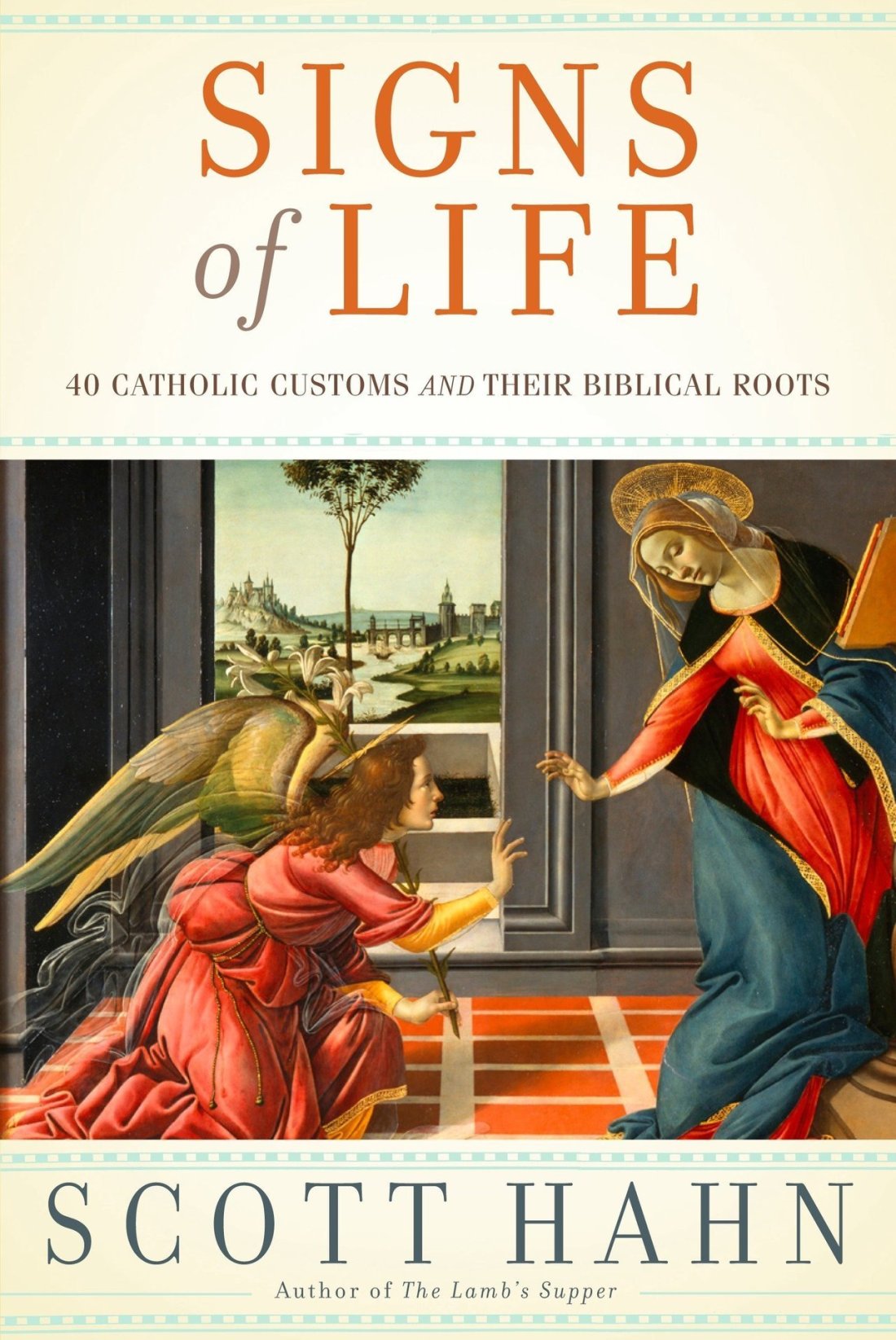
The 40 customs discussed are: Holy Water, the Sign of the Cross, Baptism, the Mass, Guardian Angels, the Liturgical Calendar, Lent and Easter, Advent and Christmas, Novenas, posture, Morning Offering, Prayers of Aspiration, the Angelus, Grace at Meals, Examination of Conscience, Bible Study, Spiritual Reading, Retreat, Confirmation, Marriage, Priesthood, Anointing of the Sick, Incense, Candles, Sacred Images, Relics, Fasting, Confession, Indulgences, Intercession of the Saints, Pilgrimages, the Presence of God, Almsgiving, The Trinity, the Rosary, Scapulars and Medals, Mental Prayer, the Tabernacle, Preparation for Death, and Prayers for the Dead.
“For decades non-Catholics and even some perplexed Catholics have questioned a number of the beliefs and especially the devotional acts of the Catholic Church. Scott Hahn addresses these questions in Signs of Life, producing crystal-clear explanations of the Church’s traditional practices. His own background as a convert makes him the perfect person to write this book.”—Fr. Benedict J. Groeschel, CFR
Yes you should get baptized. And no its not a second baptism, I believe if you get baptized it would actually be your first time getting baptized. Why? . Because Infant baptism is not a Biblical practice. An infant cannot place his or her faith in Christ. An infant cannot make a conscious decision to obey Christ. Therefore sprinkling water onto an infant is not baptism.
If you have more question or you just don’t understand I will explain it more in a upcoming post which will be called (What does the Bible say about infant baptism?)
BTW I am very happy you have been thinking about getting baptized. I really encourage it, if you are serious about Christ. I will be praying for you. God Bless.
Catholics believe, and most Protestants I believe , believe in original sin. Baptism is nessesary for the removal of original sin. It counts as a baptism, however it must be ratified as an adult – which is Why Catholics renew our baptismal vows every year and at Confirmation.
Infant Baptism became a practice because at the beginning converts were baptized as families, but as children became born into the faith there became a concern for their souls since infant mortality was a pretty big thing. Thus, babies were baptized to let them be reborn in Christ and then they could choose to be in the faith or not when they got over.
Thats just a Catholic perspective.
AFAIK, the Protestant view on Baptism is that it is an outward sign of your salvation? IDK how to phrase it. Like, if Baptism was enough to remove and forgive your sins then Jesus wouldn’t be necessary? You get Baptized after you are saved. As an act of obedience to God, and sometimes as a public declaration of your commitment to God.
Baptism is just original sin only (and sins up to that point if you’re an adult). Otherwise confession is nessesary.
I grew up Protestant and was baptized when I was about 6. A lot of Protestant denominations place importance on the baptize-ee making a conscious choice in the matter (my church was this way); the person has to say yes to Jesus themselves first (and sometimes recite the sinner’s prayer, which is asking Jesus to come into your heart and be your Lord and Saviour). There’s a lot of difference between denominations as to which ones consider baptism to be an actual sacrament vs. an outward symbol of an inward truth.
As far as the Catholic Church is concerned, Protestant baptisms are considered valid and sacramental if they are done explicitly in the name of the Father, Son, and Holy Spirit (this practice is rooted in Scripture, where Jesus gives the great commission- Matthew 28:19). However, Protestant denominations all have their own varied beliefs about Catholic infant baptism. It would depend on what each individual pastor’s interpretation of Scripture is.
Now (since I can’t resist), doesn’t the Protestant side of the Church seem rather fractured in all of this when it comes to “correct” teachings and interpretations? Ask three Protestants from three different denominations about what baptism really is and you’ll see what I mean. But Jesus Himself, just hours before He knew He was to die for our sins, prayed to the Father asking that the whole Church “be one; even as you, Father, are in me, and I in you, that they also may be in us, so that the world may believe that you have sent me” (John 17:21). The Catholic Church is unique among all Christians in that it is the ONLY branch of Christianity that is officially and completely united in its teachings. Do some Catholics stray from official teachings? Yes, but it is the person who strays while the teachings remained fixed.
I would strongly urge this anon to take all of this into account when comparing their non-denom church to the Catholic Church they grew up in. It seems to me that a lot of people leave the Catholic Church because they do not fully understand her teachings and they have an experiential encounter with Christ somewhere else. Again, as someone who has seen both sides, I GET it. I’ve had certain powerful experiences among my Protestant friends that I have only experienced on very rare occasions in a Catholic setting.
But let me say this. The Catholic Church claims that Jesus actually gives us Himself to consume when we take Holy Communion. The Church claims this is NOT a symbol, but an actual fact. As a former Protestant I can’t help but ask my Protestant brothers and sisters: If there’s even a chance that the Catholic teaching about Communion is true, is it not worth looking into? Because what could possibly be a better experience of Christ than THAT? If you reject this teaching of the Church, I humbly beg you to prayerfully read John’s Gospel, chapter 6 and ask the Holy Spirit to reveal the truth to you. He will, whether I myself am right or wrong.
As someone who has been on both sides, and who is so convinced of the rightness of the Church that I experienced painful rejection from some of my own family members, I urge every Christian to reconsider the Catholic faith. There are answers to every question you could pose concerning doctrine and practices, I promise. It just takes time to seek and find them.
everyone who asks why im going catholic asks it in a setting where it feels like i’d have to explain it in 10 seconds or less and like….. its a bit more complex than that fam if you want a real answer we gotta take this conversation somewhere other than waiting for the fast food we ordered
If Christ didn’t want us to eat His flesh in the appearance of bread, then why was He born in a city called House of Bread and laid in a food trough?
If He didn’t want that, why would He have said that He is the bread from heaven and that His flesh is truly food and that we must eat it? (And if He meant that as a metaphor, why didn’t He correct everyone when they all took it literally?)
If He didn’t want that, then why did He offer Himself as the Lamb of God for the sacrifice for our sins in the same way the Old Testament Jews offered a lamb in sacrifice, a lamb which they were required to eat the flesh of?
If He didn’t want that, why did He say, “This is my body, which is given for you” at the Last Supper, just before the first Seder at the beginning of Passover, at which they would have eaten the paschal lamb?
It is painfully obvious that Christ meant for us to literally eat His flesh and drink His blood under the appearance of bread and wine, and that’s why the earliest Christians unanimously took the Eucharist to be literally Christ’s flesh and blood.
It’s really quite simple – if He meant it literally, then He incriminates Himself as a false prophet who lead the people astray by sorcery to worship a false god. For which the penalty is death by stoning.
Either Christianity is true, and the Eucharist is false, or the Eucharist is true and Christianity is a total lie that has destroyed the lives of billions through idolatry.
According to the Catechism of the Catholic Church, paragraph 1324: “The Eucharist is the source and summit of the Christian life. The other sacraments, and indeed all ecclesiastical ministries and works of the apostolate, are bound up with the Eucharist and are oriented toward it. For in the blessed Eucharist is contained the whole spiritual good of the Church, namely Christ himself, our Pasch.”
“But here some one perhaps will ask, Since the canon of Scripture is complete, and sufficient of itself for everything, and more than sufficient, what need is there to join with it the authority of the Church’s interpretation? For this reason — because, owing to the depth of Holy Scripture, all do not accept it in one and the same sense, but one understands its words in one way, another in another; so that it seems to be capable of as many interpretations as there are interpreters. For Novatian expounds it one way, Sabellius another, Donatus another, Arius, Eunomius, Macedonius, another, Photinus, Apollinaris, Priscillian, another, Iovinian, Pelagius, Celestius, another, lastly, Nestorius another. Therefore, it is very necessary, on account of so great intricacies of such various error, that the rule for the right understanding of the prophets and apostles should be framed in accordance with the standard of Ecclesiastical and Catholic interpretation.“
Here’s another thought: Say you are right and the Eucharist means nothing, that should call into question every other miracle that Christ performed during his ministry, up to and including his resurrection.
This day saddens me because I see my Protestant brothers and sisters “celebrating” a “reformation” that has only resulted in further fracturing of Christ’s Holy Church into many divisive denominations lacking unity. Today seems like as good a day as any to point the errors of the FIVE SOLAS (which I’ve seen numerous people point to as a positive result of the reformation). Sorry, they’re not.
There are numerous articles and books which point out how the five solas fall short but for today I’ll just pull out the following relevant points from Dave Armstrong’s article 150 Reasons Why I Became (and Remain) a Catholic
86. Flaws in original Protestant thought have led to even worse errors in reaction. E.g., extrinsic justification, devised to assure the predominance of grace, came to prohibit any outward sign of its presence (“faith vs. works,” sola fide). Calvinism, with its overly stern and rigid God, turned men off to such an extent that they became Unitarians (as in New England in the late 18th and early 19th centuries). Many founders of cults of recent origin started out Calvinist (Jehovah’s Witnesses, Christian Science, The Way International, etc.). One error begets another more serious and damaging error.
[…]
100. One of Protestantism’s foundational principles is sola Scriptura, which is neither biblical (see below), historical (nonexistent until the 16th century), nor logical (it’s self-defeating) idea:
101. The Bible doesn’t contain the whole of Jesus’ teaching, or Christianity, as many Protestants believe (Mk 4:33; 6:34; Lk 24:15-16,25-27; Jn 16:12; 20:30; 21:25; Acts 1:2-3).
102. Sola scriptura is an abuse of the Bible, since it is a use of the Bible contrary to its explicit and implicit testimony about itself and Tradition. An objective reading of the Bible leads one to Tradition and the Catholic Church, rather than the opposite. The Bible is, in fact, undeniably a Christian Tradition itself.
103. The NT was neither written nor received as the Bible at first, but only gradually so (i.e., early Christianity couldn’t have believed in sola Scriptura like current Protestants, unless it referred to the OT alone).
104. Tradition is not a bad word in the Bible. The Greek paradosis refers to something handed on from one to another (good or bad). Good (Christian) Tradition is spoken of in 1 Cor 11:2; 2 Thess 2:15, 3:6, and Col 2:8. In the latter it is contrasted with traditions of men.
105. Christian Tradition, according to the Bible, can be oral as well as written (2 Thess 2:15; 2 Tim 1:13-14; 2:2). St. Paul makes no qualitative distinction between the two forms.
106. The phrases “word of God” or “word of the Lord” in Acts and the epistles almost always refer to oral preaching, not to the Bible itself. Much of the Bible was originally oral (e.g., Jesus’ entire teaching – He wrote nothing – St. Peter’s sermon at Pentecost, etc.).
107. Contrary to many Protestant claims, Jesus didn’t condemn all tradition any more than St. Paul did. E.g., Mt 15:3,6; Mk 7:8-9,13, where He condemns corrupt Pharisaical tradition only. He says “your tradition.”
108. The Greek paradidomi, or “delivering” Christian, apostolic Tradition occurs in Lk 1:1-2; Rom 6:17; 1 Cor 11:23; 15:3; 2 Pet 2:21; Jude 3. Paralambano, or “receiving” Christian Tradition occurs in 1 Cor 15:1-2; Gal 1:9,12; 1 Thess 2:13.
109. The concepts of “Tradition,” “gospel,” “word of God,” “doctrine,” and “the Faith” are essentially synonymous, and all are predominantly oral. For example, in the Thessalonian epistles alone St. Paul uses 3 of these interchangeably (2 Thess 2:15; 3:6; 1 Thess 2:9,13 (cf. Gal 1:9; Acts 8:14). If Tradition is a dirty word, then so is “gospel” and “word of God”.
110. St. Paul, in 1 Tim 3:15, states that the Church is the ground of truth, as in Catholicism.
111. Protestantism’s chief “proof text” for sola Scriptura, 2 Timothy 3:16, fails, since it says that the Bible is profitable, but not sufficient for learning and righteousness. Catholicism agrees that it is great for these purposes, but not exclusively so, as in Protestantism. Secondly, when St. Paul speaks of “Scripture” here, the NT didn’t yet exist (not definitively for over 300 more years), thus he is referring to the OT only. This would mean that the NT wasn’t necessary for the rule of faith, if sola Scriptura were true, and if it were supposedly alluded to in this verse.
112. The above eleven factors being true, Catholicism maintains that all its Tradition is consistent with the Bible, even where the Bible is mute or merely implicit on a subject. For Catholicism, every doctrine need not be found primarily in the Bible, for this is Protestantism’s principle of sola Scriptura. On the other hand, most Catholic theologians claim that all Catholic doctrines can be found in some fashion in the Bible, in kernel form, or by (usually. extensive) inference, and that the Bible is materially sufficient for salvation, if it was all one had (on a desert island or something).
113. As thoughtful evangelical scholars have pointed out, an unthinking sola Scriptura position (sometimes referred to as solo Scriptura) can turn into “bibliolatry,” almost a worship of the Bible rather than God who is its Author. This mentality is similar to the Muslim view of Revelation, where no human elements whatsoever were involved. Sola Scriptura, rightly understood from a more sophisticated (e.g., Reformed) Protestant perspective, means that the Bible is the final authority in Christianity, not the record of all God has said and done, as many evangelicals believe.
114. Christianity is unavoidably and intrinsically historical. All the events of Jesus’ life (incarnation, crucifixion, resurrection, ascension, etc.) were historical, as was the preaching of the apostles. Tradition, therefore, of some sort, is unavoidable, contrary to numerous shortsighted Protestant claims. This is true both for matters great (ecclesiology, trinitarianism, justification) and small (church budgets, type of worship music, lengths of sermons, etc.). Every denial of a particular tradition involves a bias (hidden or open) towards one’s own alternate tradition (E.g., if all Church authority is spurned, even individualistic autonomy is a “tradition,” which ought to be defended as a Christian view in some fashion).
115. Sola scriptura literally couldn’t have been true, practically speaking, for most Christians throughout history, since the movable-type printing press only appeared in the mid-15th century. Preaching and oral Tradition, along with things like devotional practices, Christian holidays, church architecture and other sacred art, were the primary carriers of the gospel for 1400 years. For all these centuries,sola Scriptura would have been regarded as an absurd abstraction and impossibility.
116. Protestantism claims that the Catholic Church has “added to the Bible.” The Catholic Church replies that it has merely drawn out the implications of the Bible (development of doctrine), and followed the understanding of the early Church, and that Protestants have “subtracted” from the Bible by ignoring large portions of it which suggest Catholic positions. Each side thinks the other is “unbiblical,” but in different ways.
117. Sola Scriptura is Protestantism’s “Achilles’ Heel.” Merely invoking sola Scriptura is no solution to the problem of authority and certainty as long as multiple interpretations exist. If the Bible were so clear that all Protestants agreed simply by reading it with a willingness to accept and follow its teaching, this would be one thing, but since this isn’t the case by a long shot (the multiplicity of denominations), sola Scriptura is a pipe-dream at best. About all that all Protestants agree on is that Catholicism is wrong, or on doctrines with which they already agree with Catholicism. Of all Protestant ideas, the “clarity” or perspicuity of the Bible is surely one of the most absurd and the most demonstrably false.
118. Put another way, having a Bible does not render one’s private judgment infallible. Interpretation is just as inevitable as tradition, and such individual interpretation is rife with one’s own traditions, and prior theological biases, whether acknowledged or not. The Catholic Church therefore, is absolutely necessary in order for true authority to exist, and to prevent confusion, error, and division.
[…]
126. Protestantism has a strong tendency of pitting faith against works (sola fide), which is a rejection of Christian Tradition and the explicit teaching of the Bible (Mt 25:31-46; Lk 18:18-25; Jn 6:27-9; Gal 5:6; Eph 2:8-10; Phil 2:12-13; 3:10-14; 1 Thess 1:3; 2 Thess 1:11; Heb 5:9; Jas 1:21-7; 2:14-16). These passages also indicate that salvation is a process, not an instantaneous event, as in Protestantism.
127. Protestantism rejects the Christian Tradition and biblical teaching of merit, or differential reward for our good deeds done in faith (Mt 16:27; Rom 2:6; 1 Cor 3:8-9; 1 Pet 1:17; Rev 22:12).
128. Protestantism’s teaching of extrinsic, imputed, forensic, or external justification contradicts the Christian Tradition and biblical doctrine of infused, actual, internal, transformational justification (which includes sanctification): Ps 51:2-10; 103:12; Jn 1:29; Rom 5:19; 2 Cor 5:17; Heb 1:3; 1 Jn 1:7-9.
129. Many Protestants (especially Presbyterians, Calvinists and Baptists) believe in eternal security, or, perseverance of the saints (the belief that one can’t lose his “salvation,” supposedly obtained at one point in time). This is contrary to Christian Tradition and the Bible: 1 Cor 9:27; Gal 4:9; 5:1,4; Col 1:22-3; 1 Tim 1:19-20; 4:1; 5:15; Heb 3:12-14; 6:4-6; 10:26,29,39; 12:14-15; 2 Pet 2:15,20-21; Rev 2:4-5.
130. Contrary to Protestant myth and anti-Catholicism, the Catholic Church doesn’t teach that one is saved by works apart from preceding and enabling grace, but that faith and works are inseparable, as in James 1 and 2. This heresy of which Catholicism is often charged, was in fact condemned by the Catholic Church at the Second Council of Orange in 529 A.D. It is known as Pelagianism, the view that man could save himself by his own natural efforts, without the necessary supernatural grace from God. A more moderate view, Semi-Pelagianism, was likewise condemned. To continue to accuse the Catholic Church of this heresy suggests a manifest ignorance of the history of theology, as well as the clear Catholic teaching of the Council of Trent (1545-63), available for all to see. Yet the myth is strangely prevalent.
Hot take: It’s okay to emphasize that Catholicism isn’t only the “smells and bells,” but if I were to have abandoned all the external signs of my faith because my relationship with Christ was failing, I would no longer be Catholic.
Call it fake or superficial if you’d like, but when I’m struggling, I’ve learned to cling for dear life to those things I can still see, touch, and smell. Medals, veils, crucifixes, candles, incense, etc., are not God. But they are tangible reminders of what I have now, what I am striving for, and what I would lose if I walked away.
I don’t wear a crucifix because I think I’m done striving for holiness, or because I think I have a perfect relationship with God. I wear a crucifix because sometimes it’s all I have.
The differences are almost uncountable because of how many sects of protestantism there is, so I wouldn’t focus so much on the differences rather than the authenticity of the beliefs. The main difference though is exactly what you said – tradition.
Catholics believe in sacred tradition alongside the Bible, where the Bible is the HIGHEST authority, but it is not the ONLY one. The Bible does not give us everything we need, and it even tells us to abide by tradition.
The reason I wholeheartedly believe Catholicism is the only true faith and the only FULLNESS of Christianity is because the doctrine and practices have not changed in any important ways since the time of Christ.
Of course it’s evolved and adapted to different cultures as it’s spread out, like how you’ll see Mass celebrated in some more regional rites in different countries where the dialect might be different and the decorations might change, but it’s still the exact same Mass everywhere on earth. But the actual faith itself, the beliefs and the doctrines and everything that makes up the core faith, has remained the exact same for 2000 years.
If you’re looking between protestantism and Catholicism I suggest looking at the early Church fathers, as well as the protestant reformation. I know when I started looking into Christian history I was totally floored at how Catholic the early Church was. I couldn’t dream of being protestant now. There are 2 quotes that I find kind of funny and relevant to this debate.
“To be deep in history is to cease to be protestant.”
“I could never join a religion founded by a Catholic priest, and that’s why I’m not protestant.” (Martin Luther was a Catholic priest)
•American Catholics in particular need to let go of their fucking politics. Liberals and conservatives need to shut the fuck up and realize our God is beyond politics and our religion may give light to it, but is not inherently tied with it.
•Capitalism in Practice As We See It is not compatible with Catholic social values
•Catholicsm is the One True Religion but the people who practice it are sometimes aasholes.
“I remember thinking to myself, these Catholics believe so many strange things that I’ll never figure them all out, even if I have a lifetime, because they say it took the church thousands of years to figure them out. But I’ve reduced it to one question now: what was the early church like? Did Jesus found a Protestant church that went bad, that is, Catholic, in the Middle Ages, or did he found a Catholic church that went bad, that is, Protestant, at the Reformation? And I can find that out just by reading the Church Fathers, the earliest Christians. So I’ll read the earliest documents of church history, prove to myself how Protestant they were, and justify my staying a Protestant, and that’ll overcome my temptation to become a Catholic. Well, you know the rest of the story, especially if you’ve read Cardinal Newman’s conversion story; that was basically his point. It was really one basic point: is it a historical fact that Jesus Christ founded the Catholic Church, or not? Is there continuity between the Catholic Church today and the thing the Gospels tell us that Jesus founded? If yes, be a Catholic; if no, don’t. And you don’t have to be a theologian to figure that out — just read the books.”


 Wide Spread Interests