People really be out here taking the Christian themes out of Lord of the Rings and The Chronicles of Narnia
I once saw someone say something like “keep your religion away from my hobbit movies” to someone else in a comment section and all I could think was “keep your scary things out of my horror movies” like my dude this is Tolkien we’re talking about if you want a story without religious influence you are looking in the wrong place
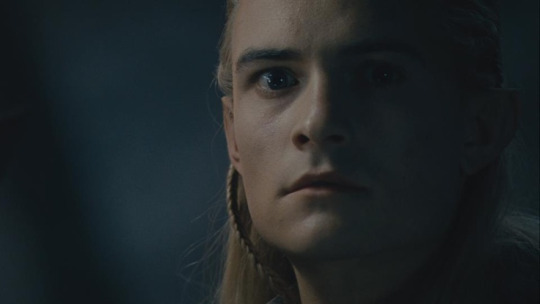
This is right after Gandalf says, “A balrog. A demon of the ancient world.”
I just love how PJ chose to cut to Legolas’ face because he is exactly who you should cut to at this moment. You need an elf to show what it really means. Other than Gandalf, the rest of the Fellowship can sense something is gravely wrong, but they don’t understand just how grave. Like Gandalf, Legolas knows the terror. He understands the gravity of what lies around that corner. He’s got a piddly little bow and he is mere steps away from a demon of the ancient world. This frame shows a kid coming to the realisation that he is way out of his depth, that this mission will take him to places he only knew to exist in legends of the Elder Days, a time long gone, barely history.
He’s probably one of the youngest elves in Middle Earth at this point. He probably grew up on stories of the balrogs, slaying the ancient High Kings of the Eldar and tearing Middle Earth apart, thousands and thousands of years ago. They are legends in old crumbling books, read illicitly by a little elfling who was kept up at night by the terrible tales.They are the monsters under the bed and the shadows in the heart of the forest. They are the beasts behind the winged hordes of hell, that older elves, who’ve seen the worst that Arda has to offer, always assured him were no more than distant nightmares, stories relegated to dust and ancient memory. Except now they are real. They are here. They are coming.
The best part is that in the books he just starts screaming when he lays eyes on it
In its right hand was a blade like a stabbing tongue of fire; in its left hand it held a whip of many thongs.
‘Ai! ai! wailed Legolas. “A Balrog! A Balrog has come!’
Legolas can be relied upon to have the correct reaction to everything.
It is not necessarily normal, or socially appropriate, or sane, but it is always 100% correct.
it’s like they’re all looking at a shiny thing in the sky and gandalf is like “a meteor is a rock that falls from space” and legolas is the only one who’s seen pictures of tunguska
“6) Tolkien’s hero was average, and needed help, and failed. This is the place where most fantasy authors, who love to simultaneously call themselves Tolkien’s heirs and blame him for a lot of what’s wrong with modern fantasy, err the worst. It’s hard to look at Frodo and see him as someone extra-special. The hints in the books that a higher power did choose him are so quiet as to be unnoticeable. And he wouldn’t have made it as far as he did without his companions. And he doesn’t keep from falling into temptation. A lot of modern fantasy heroes are completely opposite from this. They start out extraordinary, and they stay that way. Other characters are there to train them, or be shallow antagonists and love interests and worshippers, not actually help them. And they don’t fail. (Damn it, I want to see more corrupted fantasy heroes.) It’s not fair to blame Tolkien for the disease that fantasy writers have inflicted on themselves. […] Fantasy could use more ordinary people who are afraid and don’t know what the hell they’re doing, but volunteer for the Quest anyway. It’s misinterpretation of Tolkien that’s the problem, not Tolkien himself.”
The whole point of The Lord Of The Rings… like, the WHOLE POINT… is that it is ultimately the hobbits who save the world. The small, vulnerable, ordinary people who aren’t great warriors or heroes.
Specifically, Sam. Sam saves the world. All of it. The ultimate success of the great quest is 100% due to a fat little gardener who likes to cook and never wanted to go on an adventure but who did it because he wasn’t going to let his beloved Frodo go off alone. Frodo is the only one truly able to handle the ring long enough to get it into Mordor – and it nearly kills him and permanently emotionally damages him – but Sam is the one who takes care of Frodo that whole time. Who makes him eat. Who finds him water. Who watches over him while he sleeps.
Sam is the one who fights off Shelob.
Sam is the one who takes the Ring when he thinks Frodo is dead.
Sam is the one who strolls into Orc Central and saves Frodo by sheer determination and killing any orc who crosses him. (SAM THE GARDENER GOES AND KILLS AN ACTUAL ORC TO GET FRODO SOME CLOTHES LET’S JUST THINK ABOUT THAT). And then Sam just takes off the Ring and gives it back which is supposed to be freaking impossible and he barely even hesitates.
Sam literally carries Frodo on the last leg of the journey. On his back. He’s half-starved, dying slowly of dehydration, but he carries Frodo up the goddamn mountain and Gollum may get credit for accidentally destroying the ring but Sam was the one who got them all there.
Sam saved the world.
And let’s not forget Pippin and Merry, who get damselled out of the story (the orcs have carried them off! We must make a Heroic Run To Save Them!) and then rescue themselves, recruit the Terrifying Ancient Powers through being genuinely nice and sincere, and overthrow Saruman before the ‘real’ heroes even get there.
Let’s not forget Pippin single-handedly saving what’s left of Gondor – and Faramir – by understanding that there is a time for obeying orders and a time for realizing that the boss is bugfuck nuts and we need to get help right now.
Let’s not forget Merry sticking his sword into the terrifying, profoundly evil horror that has chased him all over his world because his friend is fighting it and he’s gonna help, dammit and that’s how the most powerful Ringwraith goes down to a suicidally depressed woman and a scared little hobbit.
Everything the others do, the kings and princes and great heroes and all? They buy time. They distract the bad guys. They keep the armies occupied. That is what kings and great leaders are for – they do the big picture stuff.
But it is ultimately the hobbits who bring down every villain. Every one. And I believe that that is 100% on purpose. Tolkien was a soldier in WWI. His son fought in WWII. (And a lot of The Lord Of The Rings was written in letters to him while he did it.)
And hey, look, The Lord Of The Rings is about ordinary people – farmers, scholars, and so on – who get pulled into a war not of their making but who have to fight not only because their own home is in danger but so is everyone’s. And they’re small and scared but they do the best they can for as long as they can and that is what actually saves the world. Not great heroes and pre-destined kings. Ordinary people, doing extraordinary things because they want the world to be safe for ordinary people, the ones they know and the ones they don’t.
Ordinary people matter. They can save the world without being great heroes or kings or whatever. And that is really important and I get so upset when people miss that because Aragorn and Legolas and Gimli and Gandalf and all the others are great characters and all but they are ultimately a hobbit delivery system.
It is ordinary people doing their best who really change the world, and continue doing so after the war is over because they have to go home and rebuild and they do.
If nothing else, I have to reblog this for the phrase “hobbit delivery system.” So accurate it hurts.
What I love too is how even the foretold king and the assorted great heroes themselves all come to recognize that their main (and by the end, only) role is to distract Sauron. To the point that by the end they’re all gathered up before the black gates of Mordor in order to keep his attention focused on them, with only the hope – not the certainty – that they can buy Frodo whatever remaining time he needs, if he’s even still alive.
One thing the movies left out but has always been such a key part of the books for me was how when the hobbits returned home, they found that home had been changed too.
The war touched everywhere. Even with all they did in far-off lands to protect the Shire, the Shire had still been damaged, both property and lives destroyed, and it wasn’t an easy or simplistically happy homecoming. They had to fight yet another battle (granted a much smaller one) to save their neighbours, and then spent years in rebuilding.
“The markings upon the band begin to fade. The writing, which at first was as clear as red flame, has all but disappeared… a secret now that only fire can tell.” – The Lord of the Rings: Fellowship of the Ring, 2001
Want to knit this scarf? You can download my free pattern here! 🙂
what she means: the words “christmas tree” are used in the hobbit, and since we know that bilbo is the author of the hobbit, hobbits must have christmas which means there must be a middle earth jesus. but hobbits seem to be the only ones who have the concept of christmas which means it was probably a hobbit jesus. but frodo says in return of the king that no hobbit has ever intentionally harmed another hobbit so who crucified hobbit jesus?? were there other hobbit incarnations of religious figures?? was there hobbit moses?? did jrr tolkien even think about this at all??
Wait wait I might actually have an answer
Tolkien wrote The Hobbit like waaaay before he even dreamed up the idea for Lord of the Rings, so when he DID dream up LotR, he had a whole bunch of stuff that didn’t make sense. Like plotholes galore
Like for example in the first version Gollum was a pretty nice dude who lost the riddle contest graciously and gave Bilbo the ring as a legit present and was very helpful and it was super nice and polite and absolutely nobody tried to eat anyone because this is a story for kids and that’s very rude
But that doesn’t work with LotR, so Tolkien went back and re-released an updated version of The Hobbit with all the lore changes and stuff to fix everything that didn’t work
This is the version we know and love today
BUT rather than pretend the early version never existed, Tolkien went and worked the retcon into the lore
If you pay attention in Fellowship, there’s a bit where Gandalf is telling Frodo about the ring and he mentions how Bilbo wasn’t entirely honest about the manner in which it was found
To us modern readers, this doesn’t make a ton of sense, so mostly we just breeze by it–but actually that line is referencing the first version of The Hobbit
The pre-retcon version of the Hobbit is canonically Bilbo’s original book. The original version with Nice Gollum is canonically a lie Bilbo told to legitimize his claim to the ring and absolve him of the guilt he feels for his rather shady behavior
Then the post-retcon version is an in-universe edited edition someone went and released later to straighten out Bilbo’s lies
So it’s 100% plausible that the in-universe editor who fixed up Bilbo’s Red Book and translated it from whatever language Hobbits speak was a human who knew about Christmas Trees and tossed the detail in to make human readers feel more at home, because that’s the kind of thing that sometimes happens when you have a translator editor person dressing up a story for an audience that doesn’t know the exact cultural context in which the original story was written
Tolkien was a medieval scholar and medieval stories are rife with that sort of thing, so like… yeah
Not only all that, but Tolkien was also working within a frame narrative that he wasn’t the real author, but a translator of older manuscripts; so, in-universe, the published The Hobbit isn’t actually Bilbo’s book, but rather Tolkien’s copy of an older copy of an older copy of an older copy of Bilbo’s book. So when errors and anachronisms came up, he would leave them there instead of fixing them, and he may have even put some in intentionally; what we’re supposed to get from the “Christmas tree” bit is that the first scribe to translate the book from Westroni to English couldn’t come up with an accurate analogue for whatever hobbits do at midwinter.
Yes. Another example of tolkien doing this is him using, for instance, Old High Gothic to represent Rohirric – not because the people of Rohan actually spoke that language, but because Old High Gothic had the same relationship with English that Rohirric had with Westron (Which is the Common Language spoken in the West of Middle-Earth). There’s tons of that stuff in the book.
Like, Merry and Pippin’s real names (In Westron) are Kalimac Brandagamba and Razanur Tûk, respectively (to pick just one example of this). Tolkien changed their names in English to names which would give us English-speakers the same kind of feeling as those names would to a Westron-speaker. Lord of the Rings is so much deeper than most readers realise.
tolkein’s entire oevre is just one epic in-joke with the oxford linguistics department imo
No that’s right! The basic point still stands and is neat but a lot of Rohirric names are translated as Old English, like Theodred and Eorl and so on. Another interesting thing is that he sometimes modernized them to modern English because, apparently, those names were intelligible to Westron speakers, either because Gondorians knew them or because the Hobbits recognized them from their dialects (they once lived near the Rohirrim and borrowed a bunch of words, including their name for themselves). Here’s a good link about it from Tolkien Gateway, it’s SUPER cool.
Also if I correctly recall (it’s been a while so I might not) there was a draft of TTT where Tolkien intended for Theoden to greet Our Heroes in Old English. This was in The Treason of Isengard and I have a very distinct memory of reading it at about fifteen and being completely floored and baffled by the fact that he just…wrote an entire speech in Old English for Theoden to say. Like, can you even believe. I absolutely love how much flavor and care he put into the languages in LOTR.
I am Not A Linguistics Person but I *did* read the appendices so…
Hobbits gender -o and -a name endings in the opposite way, and in the “translation” Tolkien changed eg Frodo’s -a name to make it easier on the audience.
I’m not sure which… Romance? European? languages even have this convention, other than Italian and Spanish, but it amuses me that English actually only has the female half of it and all the male -o names we know are due to exposure to other groups.
Anyway that guy was a massive nerd and I love it.
With regards to Christmas:
In LOTR, pretty much all sympathetic characters are… worshippers of the Lord, who is called Eru Illuvatar. (”he who stands alone”). When Gandalf confronts the Balrog and mentions “the Secret Fire”, he means the Holy Spirit and/or the capacity to create.
However, this is a pre-Incarnation and possibly even pre-Mosaic world.
And LOTR is envisioned as a distant past history of our own world…
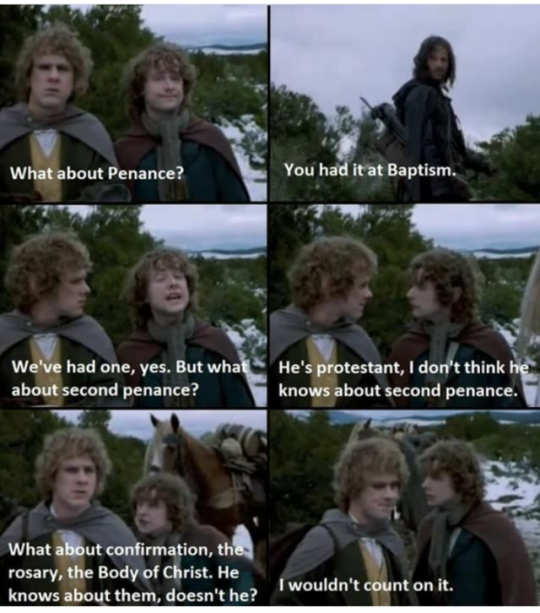
I don’t get it. Why are Catholics obligated to like Boromir?
mostly it’s a joke on the supposed legalism of Catholicism, and also a joke on how Tokien was Catholic and had Christian themes in his character arcs and themes
Actor Christopher Lee served in the
British special forces during WWII.
While filming The Lord of the Rings:
The Return of the King, he was told
to scream when his character gets
stabbed. He replied, “Have you any
idea what kind of noise happens
when somebody’s stabbed in the
back? Because I do.” Source


 Wide Spread Interests